

You wake up feeling alright, but somewhere between reading your morning e-mails, driving to work, and long hours of hardwork, the familiar episode kicks in: Your temples ache, and tension builds up around your head. For some, this has become a daily battle they’ve quietly accepted as an inevitable part of daily life.
Tension headaches are the most common form of primary headaches. Based on recent stats, it affects about 30-78% of the general population. Despite being this common, tension headaches tend to be managed ineffectively as most people simply go for painkillers until the symptoms become unbearable. However, these headaches should not simply be endured. In most cases, there’s more that can be done to ensure sustainable results.
We’ll look at everything you need to know about tension headaches, including their nature, causes, and effective treatment options.
So, What's a Tension Type Headache(TTH)?
A TTH is a neurological disorder, characterised by mild-moderate headache attacks on both sides of your head, especially around your temples. Most patients describe it as a tight band around the forehead that often spreads to the neck, shoulders, and sometimes behind the eyes. Tension headaches are categorised into 3 types based on frequency of symptoms:
Frequent Episodic TTH

According to the International Headache Society Classification, a tension-type headache should be classified as “Frequent” when it fits the following criteria:
- Occurs for more than 12 days and less than 180 days/year.
- At least 10 episodes occurring more than 1 day, and less than 15 days/month for at least 3 months.
Like other tension type headaches, it retains the key features except for frequency. This type can be further categorised into subtypes based on the presence of tenderness around the affected areas:
- Infrequent episodic tension-type headache associated with pericranial tenderness.
- Infrequent episodic tension-type headache not associated with pericranial tenderness.
Infrequent Episodic TTH
As the name suggests, this features a much lower frequency of episodes. The International Headache Society classification draws the line at a frequency of less than 12 days/year.
Like frequent episodic headaches, they’re further categorised into two based the presence of tenderness in affected areas:
- Infrequent episodic tension-type headache associated with pericranial tenderness.
- Infrequent episodic tension-type headache not associated with pericranial tenderness.
Chronic Tension-type Headaches

Chronic TTH is much more frequent compared to the other types. According to the International Headache Society classification, this includes headaches that are:
- More than 180 days/year.
- More than 15 days/month for at least 3 months.
Probable Tension Type Headaches
These are headaches that don’t fit into a type or subtype of Tension Headaches described above. Like the other types, they can also be categorised into three based on frequency and behavior of symptoms:
- Probable Infrequent Episodic Tension-type Headache.
- Probable frequent Episodic Tension-type Headache.
- Probable Chronic Tension-type Headache.
Causes: The Most Common Triggers We See in Our Clients
Well, there’s no one single isolated cause behind TTH’s. However, our experience and research studies over the past decade identify a number of factors that interact to cause associated symptoms:
Pain sensitivity and perception
Patients with TTH tend to have altered pain processing in the central nervous system. For instance, patients with Chronic Tension-type headache tend to have what’s known as “sensitization”, which basically involves the central nervous system being overly sensitive to pain signals coming in from other structures involved in TTH i.e muscles and other tissues around the skull.
Trigger Points and Muscle Dysfunction
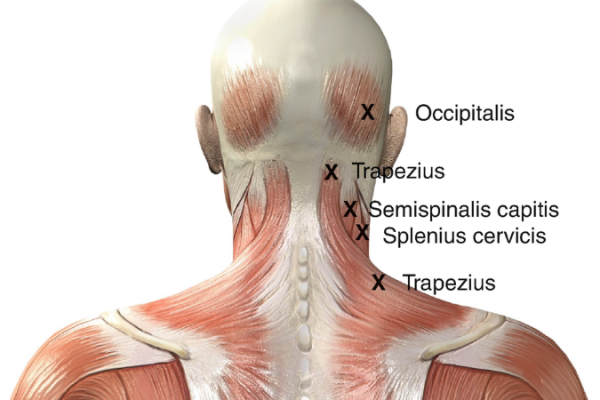
Studies have linked local issues within muscles and other soft tissues around the head and neck as a key underlying factor. Increased tension in muscles around the skull(pericranial muscles) is one of the key factors. Scientific investigations have observed that these muscles tend to be tight on both on and off days in affected individuals.
Trigger points are another key factor. In case you’re not aware, trigger points are hyper-sensitive spots within a tight bundle of muscle fibers. They show up as tender nodules you can feel inside an affected muscle, and may cause a lot of pain at rest or whenever the muscle is stressed.
The idea of trigger points being part of TTH comes from the fact that TTH patients exhibit tender points in muscles around the skull, which respond to conventional methods for treating trigger points.
Altered Brain Chemistry
Neurotransmitters are chemicals which are responsible for transmitting signals between nerve cells in the nervous system. Some neurotransmitters play a key role in the transmission of pain signals to the brain, as well as how it processes and interprets them. For instance, patients with TTH show higher activity relating to neurotransmitters like Serotonin and Nitric Oxide, which increase activity of nerve pathways associated with pain.
Long Term Outlook: How it typically turns out for our clients in the long run
Most patients with TTH completely recover, or experience significant reduction of symptoms in 1-3 years. A key study done by A. Lyndberg and colleagues on long-term outcomes observed that:
About 45% of patients experienced complete recovery or infrequent symptoms while 39% were still experiencing frequent attacks at a 3-year follow up.
Another point worth noting is that there’s a close link between type of headache and quality of long term outcomes. Chronic tension type headaches are associated with poor long term outcomes. Other factors include coexisting disorders(i.e Migraines), psychological stress, and sleep problems.
Managing TTH
Once the diagnosis is made, professionals determine the best way forward depending on the nature of the condition. The treatment usually combines drug and non-drug treatments to address the symptoms:
Medication

Basic anti-inflammatories or painkillers (i.e NSAIDS, Paracetamol) are typically used as first-line treatment for acute attacks. On the other hand, daily preventive management is considered for patients with frequent TTH and those who hardly respond to basic anti-inflammatory medication. Amitriptyline is considered the most effective drug here. In a typical case, it’s started on a low dosage of 10-25mg/day, and increases gradually if needed.
Physiotherapy Management(Our Approach for treating TTH)
Physiotherapy techniques are the most commonly used non-drug treatments in TTH. The treatment goals are identical to medical management:
Decrease pain in the short and long term, and optimise function across all key aspects of wellbeing. There are three main types of intervention in physical therapy when it comes to TTH.
Manual techniques

This features a variety of hands-on treatments aimed at reducing pain intensity and frequency, as well as restoring normal function in the affected structures. Key techniques include:
- Joint Mobilisation: Involves controlled, gentle movements applied to joints of the upper spine. It’s mainly used when dysfunctions in these joints are a proven driver of TTH symptoms.
- Joint Manipulation: This mainly involves quick thrusts/movement applied to spinal joints to elicit the same effect as mobilisations.
- Soft tissue techniques: Massage techniques applied to affected muscles and other soft tissue structures. These are especially highly effective when there are contributing factors like trigger points and pronounced muscle tightness in the neck and around the skull.
Exercise

Emerging research evidence continues to show exercise as a highly effective strategy for dealing with Tension-type headaches. A 2025 research review on exercise and chronic tension-type headaches furnishes one of the latest pieces of evidence.
After analysing 10 key studies, the researchers concluded that exercise interventions provide a safe and effective way of improving pain processing and function in TTH patients. Key exercises used in the studies included strength, cardiovascular, and relaxation training.
Passive Treatments

This includes tools, devices, and other physical agents used to alleviate symptoms and improve function. Good examples include:
- Dry Needling: This is one of the most effective passive methods for treating TTH. It involves insertion of thin needles into muscles and other affected soft tissue structures to reduce pain and tension. This can be a powerful tool for pain relief when applied in the right context. Check it out here for more details.
- Heat and Ice Therapy: Acute pain may respond favourably to ice packs, while heat packs placed on affected areas can help with managing pain in chronic headaches.
If this sounds like something that can help, and you’re looking for a qualified physiotherapist in Western Sydney, St Clair areas, reach out to us here.
How We Helped Carol Get long-lasting Relief from TTH

Carol(pseudonym), a 33-year-old woman, was referred to us by one of our referring pain specialists for further evaluation and management. She’d been diagnosed with TTH about a week earlier after a series of recurrent attacks that started about 3 months earlier.
She’d been self managing since then until it became obvious she needed help. The doctor added Amitriptyline to her regimen, which helped with decreasing the intensity and frequency. However, the symptoms were persistent, leading to the referral.
On assessment, we discovered multiple trigger points in muscles around her upper neck area, and around the skull. Also, there was movement and postural issues that made her condition worse. We engaged soft tissue and joint manual techniques as our main intervention in the early stages of treatment to reduce pain and improve mobility.
The immediate results were rather amazing: The pain was down by 80% by the end of the first session. We continued treatment for the next 6 sessions while integrating other forms of treatment like aerobic and strength training.
In a month, the symptom pattern became more of an Infrequent TTH. By the end of 3 months, the pain was gone.
Get in Touch with US
Whether it’s a new diagnosis or something you’ve been wrestling with for months or years, you shouldn’t face TTH alone with a bunch of pills. A lot more can be done for better and sustainable outcomes. Physiotherapy opens doors to non-drug treatments that can make a huge difference in the short and long term. Our physiotherapists specialise in both manual and active treatments that not only reduce your pain in the short term, but help you improve overall physical function in the long run. Reach out to us through the “book appointment” button up top, or simply click here for more details. Let’s get started today.
Frequently Asked Questions
There’s no single timeline that applies to every TTH patient undergoing physiotherapy. Results vary depending on the type, primary underlying mechanisms, type of physiotherapy treatment used, and other factors.
Ideally, as soon as you start feeling the symptoms discussed above, or just after the diagnosis is made. Your Physiotherapist should be able to assess the condition and proceed with the right treatment, which may include referring for further medical review if necessary.
Studies have shown that strength, aerobic, and other relaxational exercises can help with providing significant relief in TTH patients. However, the exercise programs need to be properly tailored to your unique needs. This is why a professional assessment is critical before jumping into any routine.


